
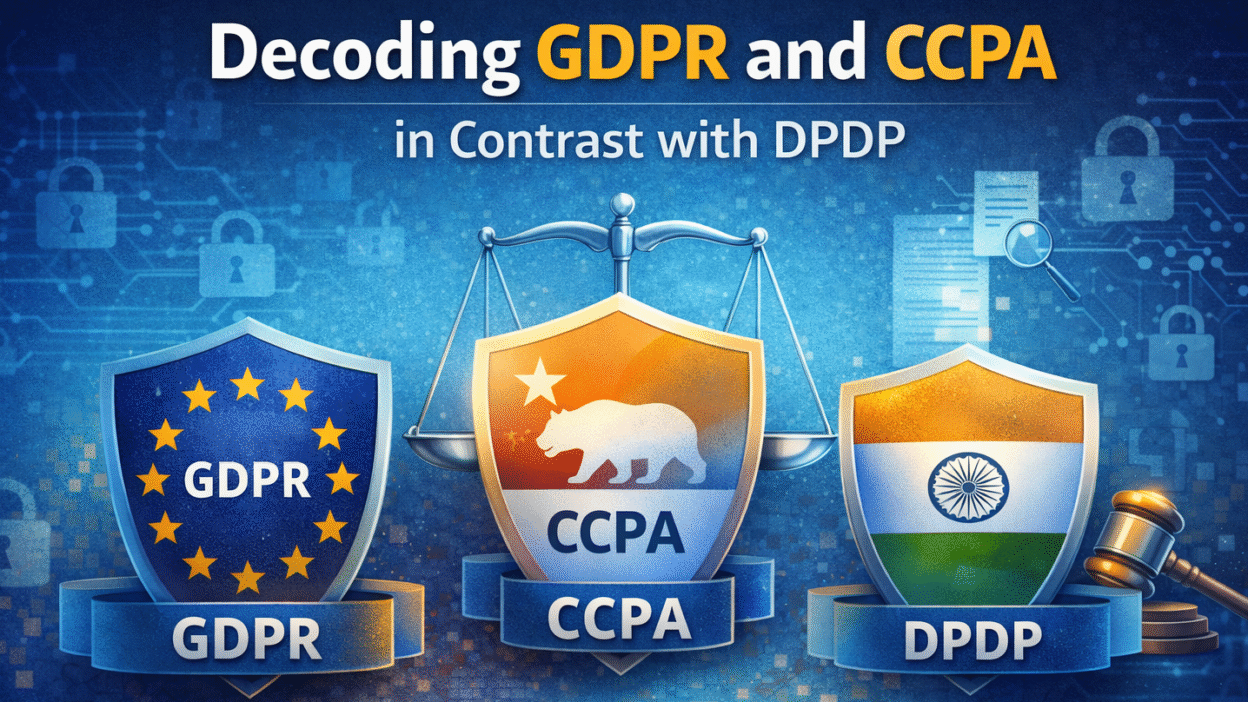
Evidently, data is the new fuel of modern life. All the businesses thrive on it, the government craves it, and individuals just want control of it. Over the past decade, data privacy laws have exploded worldwide, responding to massive breaches, surveillance scandals, and endless tracking.
Initial steps were taken by the European Union with the emergence of GDPR in 2018, focusing on strict principles. Then California entered with CCPA in 2020, letting consumers say “no” to data sales. And now India has joined with DPDP in 2023 to protect over a billion digital users.
These laws have already led to billions in fines. The main motive of these laws is to help rebuild confidence, step by step.
Table of Contents
- Introduction to GDPR CCPA in Contrast with DPDP
- Scope and Applicability
- Individual Rights Comparison
- Consent Mechanisms
- Data Security and Breach Response
- A detailed comparison table
- Enforcement Mechanisms
- Compliance Obligations for Businesses
- Cross-Border Data Flows
- Future Outlook and Harmonization Trends
Recent Developments
Here’s what’s new:
| Law | Key Changes in 2025-26 |
| GDPR | Easier rules for small businesses, clearer AI guidelines |
| CCPA | Required security audits and new opt-outs for automated decisions starting January 2026 |
| DPDP | November 2025 Rules bring a 12-18 month rollout, registered consent managers, and lists of restricted countries for data transfers |
Scope and Applicability
Territorial reach and business thresholds
These laws apply differently based on where you operate:
| Law | Who It Covers | Size Requirements |
| GDPR | Anyone’s data if they’re in the EU | None—big or small companies |
| CCPA | People living in California | Over $25M revenue or 100K users |
| DPDP | Digital data from people in India | None—focuses only on digital |
GDPR reaches anywhere in the world if EU data is involved. CCPA lets smaller companies skip it. DPDP targets India’s online space without size limits.
Exemptions (public data, non-profits, government)
- GDPR carves out public authorities’ processing for official tasks, research with safeguards, and purely personal/household activities. Non-profits? Often exempt if not commercial. Public domain data, like news? Fair game.
- CCPA skips non-profits entirely, plus public agencies and de-identified/aggregated data. Health research under HIPAA gets a pass too. Government? Broad immunity for official duties.
- DPDP only applies to personal data in digital form. It skips non-personal data, publicly available info, state security, legal rights, and most government functions. Non-profits are not automatically exempt; they must comply if they target individuals in India digitally. This keeps it focused on private digital flows.
Individual Rights Comparison
Core rights (access, deletion, objection)
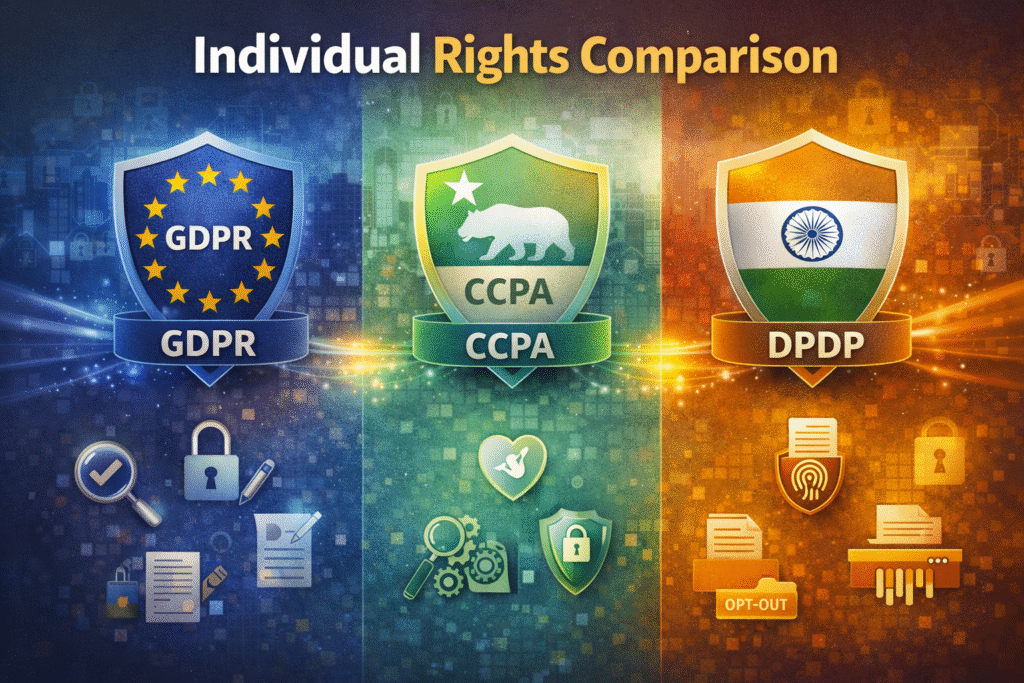
At heart, these laws hand power back to people through the stronger data subject rights. Access rights let individuals peek behind the curtain—what data you hold, why, and with whom it’s shared. Detailed records of how data is used are required by Europe’s GDPR. As for California’s CCPA, companies are required to tell users twice a year what data they collect and where it comes from. India’s DPDP has it the simple way; they need companies to have short summaries to make data protection easy to understand for everyone.
Deleting your data is now a powerful right everywhere. With Europe’s GDPR, you can force the companies to erase your information unless they are legally required to keep it. Similarly, with California’s CCPA, you have the right to wipe your data, but businesses can keep your data if it is needed for an essential ongoing task. DPDP mandates erasure once the purpose ends—clean, no fuss.
Objections vary. GDPR blocks marketing or automated decisions easily. Under CCPA, it is easy for you to make companies stop selling your data. As for India’s DPDP Act, the process is similar, but it is more restricted.
Unique features like portability and opt-out
What sets them apart is their special extras:
| Feature | GDPR | CCPA | DPDP |
| Data Portability | Yes, easy export | No | No |
| Opt-out of Sales | Limited | Yes, main focus | Through consent |
| Full Erasure | “Right to be forgotten” | With exceptions | After use ends |
Consent Mechanisms
Models
The process of getting permission is different for each:
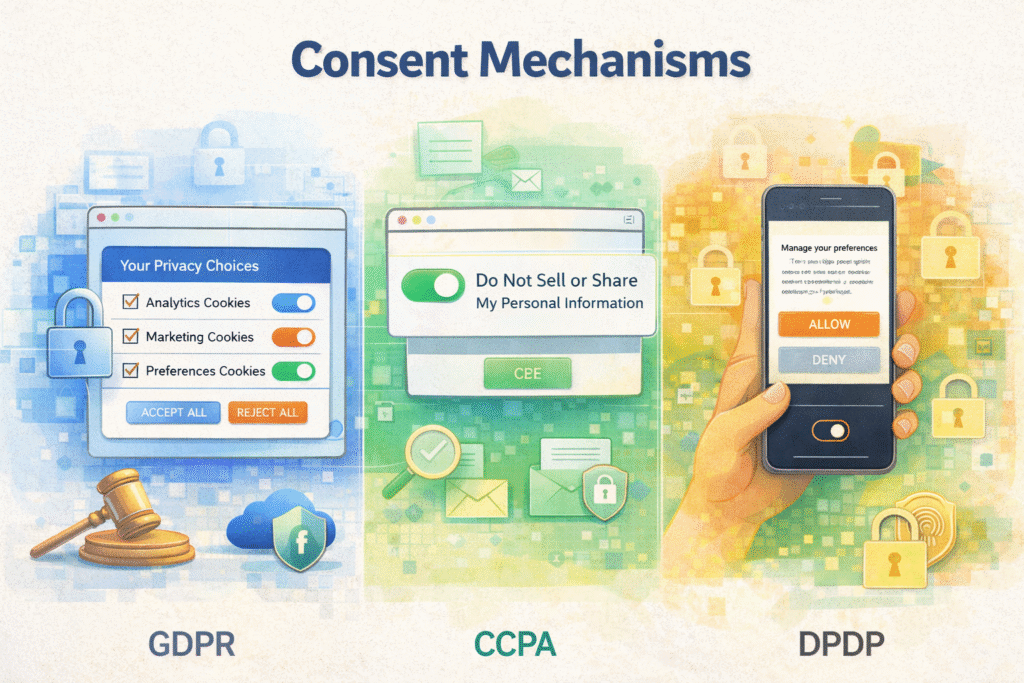
- GDPR builds a fortress: It is important for you to consciously agree (check “yes”) to each way a company uses your data. You must give this information willingly, fully understood, and easy to cancel instantly. Simply said, you are the boss of your data.
- CCPA plays the cool rebel: opt-out rules the day. No begging for permission to sell or share—users just wave a “Do Not Sell” flag via banners or global signals, and you’re bound to obey.
- DPDP: Consent is the sole monarch here. Granular, verifiable opt-in every time, logged digitally for proof. Pull the plug anytime. “Deemed consent” sneaks in for necessities like payroll, but forget broad legitimate interests—it’s consent or bust.
Sensitive and children’s data
Extra care for health info or kids:
| Type | GDPR | CCPA | DPDP |
| Sensitive | Special clear consent | Opt-in for sales | Same as regular |
| Children | Parents for under 16 | Parents for under 13 | Parents for 18 |
DPDP aims to protect more kids, matching India’s young online population.
Data Security and Breach Response
Security obligations
Every law is designed to provide good protection, but
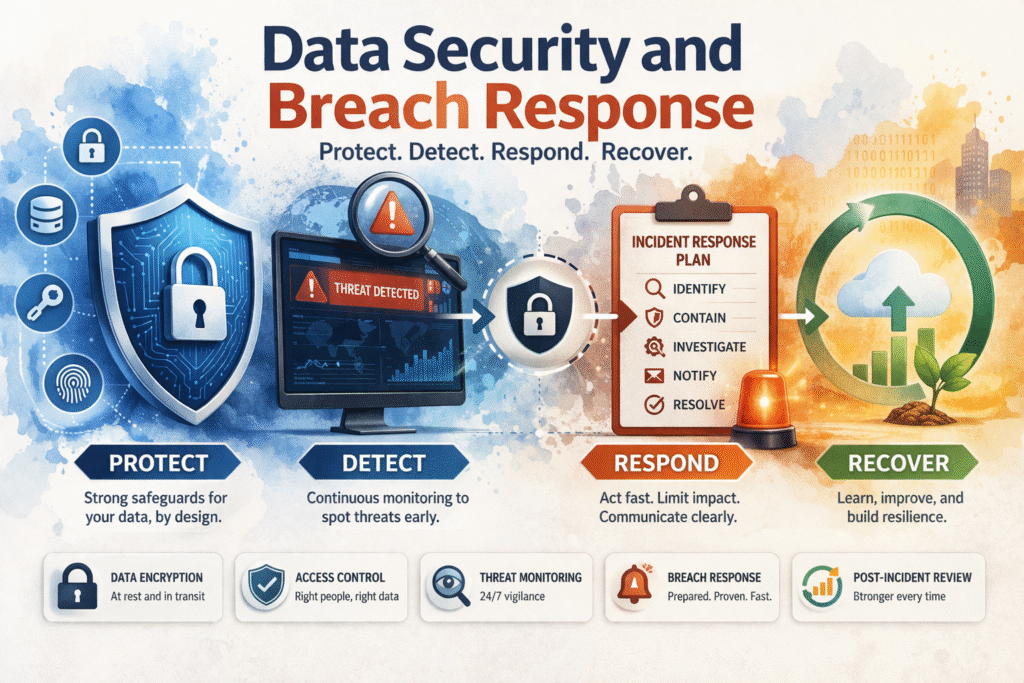
- GDPR: This law requires companies to build data security into their products and systems at the very initial point through privacy by design principles. This simply means protecting the data by default (e.g., using encryption and hiding identities) and performing ongoing risk assessments, especially for high-stakes projects. You can imagine it as building a vault that is constantly tested for safety. It is important for companies to prove that they are taking necessary steps to prevent leaks of Personally Identifiable Information (PII) and other sensitive data.
- CCPA/CPRA: Under this act, by 2026, major companies must use practical and cybersecurity measures, like firewalls and audits, to protect sensitive data. No deep risk assessments (DPIAs) are required, but strict contracts with vendors are essential. Rather than focusing on paperwork, the main focus is on actual protection results, with high risks of lawsuits and poor security.
- DPDP: This act requires companies to keep user data safe. It is important for them to have contracts with vendors who handle data and tag non-personal data. As for children’s protection, large companies must have extra checks, like independent audits and self-certification. They should use records and yearly reports to ensure safety, instead of complex and preemptive checks (DPIAs). This act is designed for the digital age and has less paperwork than Europe’s GDPR.
Notification timelines and risk assessments
When data breach or data leak happens:
| Who to Notify | GDPR | CCPA | DPDP |
| Authorities | Within 72 hours | As soon as reasonable | 72 hours with details |
| Users | If high risk | For breaches | Right away |
DPDP puts users first—a big plus for quick alerts.
A detailed comparison table
| Aspect | GDPR | CCPA/CPRA | DPDP Act & Rules |
| Scope | EU residents’ data worldwide; all personal data | CA residents; businesses >$25M revenue or 100K data subjects | Digital personal data of Indian data principals targets India |
| Applicability Threshold | None | revenue/data volume thresholds | No thresholds; excludes non-digital/public data |
| Individuals’ Rights | Access, rectification, erasure, portability, objection | know/disclose, delete, opt-out sale/sharing, limited correction | Access summary, correction, erasure post-purpose; no portability |
| Consent Model | Freely given/specific; legitimate interests allowed; withdrawal easy | Opt-out focus for sales; notices; opt-in sensitive (CPRA); 2026 banners | Consent-centric (verifiable); deemed consent exceptions; managers |
| Children’s Data | Parental consent under 16 (varies) | Opt-in restrictions | Verifiable parental consent (under 18) |
| Breach Notification | 72 hrs to DPA for users if high-risk | Reasonable time to AG/users; private suits | Immediate to users; 72 hrs detailed to the board |
| Penalties | €20M/4% global turnover; DPAs | $2.5K-$7.5K/violation; CPPA; 2026 audit focus | Up to ₹250 Cr. Data Protection Board |
| Cross-Border Transfers | Adequacy/SCCs/BCRs; Schrems II | Contracts with providers; no adequacy | Allowed unless blacklisted; phased rules |
| Processor Duties | Contracts, security, DPA, records/DPIAs | Service provider contracts; 2026 cybersecurity audits | Contracts; significant fiduciaries: audits, DPO-like |
| Recent Updates (2025-26) | Proposed SME exemptions, AI interests, cookie standardization | CPRA amendments: phased audits, ADMT, sensitive data Jan 2026+ | Nov 2025 Rules: phased rollout (12-18 mo), consent mgr regs |
Enforcement Mechanisms
Regulatory bodies
- GDPR spreads power across national Data Protection Authorities (DPAs) like Ireland’s DPC or France’s CNIL. All the data privacy rules are handled locally in each country, but the EDPB makes sure that everyone works together. Investigations begin after complaints or audits, and if there is a dispute, it goes to European courts. Fines follow due process, with public naming for deterrence.
- CCPA/CPRA centralizes muscle in California’s Privacy Protection Agency (CPPA), the first dedicated U.S. privacy cop. They probe violations, issue curative orders, and slap fines post-hearing. There are no scattered or messy rules here; there is a streamlined process using 2026 audits to guide future work.
- The DPDP Act uses a central and independent board of experts that are appointed by the government to manage data protection. All the complaints must go to a company’s Data Protection Officer (DPO). If the issue is not resolved, the board investigates issues, penalizes or orders companies to stop misusing the data.
Private rights
- GDPR limits direct suits. This means you can’t directly sue the company. Individuals must complain to DPAs, who enforce it. Some EU states allow group actions, but they’re regulator-led. Appeals hit national courts.
- CCPA unleashes private right of action for breaches—consumers claim $100-$750 per incident, no proof of harm needed. Attorneys fuel class actions; businesses settle fast.
- DPDP shuts the courtroom door: no private actions. Everything funnels to the board’s panelized grievance system—faster, cheaper—but critics worry about bottlenecks. Appeals go to administration first, then specialized tribunals.
Compliance Obligations for Businesses

Privacy notices, audits, DPOs
Key data governance duties compared:
| Duty | GDPR | CCPA | DPDP |
| Notices | Detailed layers | Pup-up banners | Simple purpose list |
| Audits | Risk assessments | Security checks 2026 | For major companies |
| Officers | Required DPO | Request handlers | For big players |
Multi-jurisdictional tools
Global businesses crave overlap hacks. Consent management platforms (CMPs) bridge gaps. To put it in simple words, it handles GDPR banners, CCPA opt-outs, and DPDP verifiables in one dashboard, now with 2026 consent manager integrations for India to simplify consent management. Privacy tech stacks like OneTrust or TrustArc map data flows across borders, auto-generating notices compliant everywhere.
Crosswalks help too: GDPR’s legitimate interests test covers CCPA’s “business purpose” exceptions, easing alignment. Training modules unify staff on rights requests—verify once. serve all. For transfers, standard clauses (SCCs) nod to DPDP’s conditions. Tools evolve fast: AI-driven mappers spot overlaps, slashing multi-law chaos. Smart firms treat these as profit centers—trust builds revenue.
Cross-Border Data Flows
Transfer mechanisms
Sending data overseas:
- GDPR builds a fortress with adequacy decisions (greenlight for compliant countries), Standard Contractual Clauses (SCCs), or Binding Corporate Rules (BCRs) for transfers, following principles reinforced by the Schrems II ruling.
- CCPA/CPRA shrugs at strict transfers, focusing on service provider contracts that limit use and demand security. No adequacy ritual or blanket bans—just ensure vendors don’t “sell” data.
- DPDP opens doors wider. The transfers are allowed abroad unless the government blacklists a country. No SCCs are needed, but fiduciaries contract processors with security riders.
Global implications
Global businesses are juggling multiple privacy laws. For instance, there is a U.S.-based company that is working in the EU, California, and India; that particular company has to navigate 3 different rulebooks.
There is a common factor in data privacy laws: Europe’s GDPR has strict rules, California’s CCPA has direct rules, and India’s DPDP has flexible rules. These rules may protect the user data across Asia, but having different laws can make things complicated for businesses. With these different rules, there will be an increase in legal costs, and it will require companies to manage multiple and complex privacy notices. However, smart moves like using standard contracts, the EU-U.S. Data Privacy Framework, and unified consent tools can streamline things.
As the rules imply, the risks are high. One small data mistake, like breaking transfer rules, can cause huge global fines. However, the situation forces better security, with India’s growth helping cloud services and California’s strict rules strengthening safety. In order to manage this, firms are creating local data hubs to follow laws while keeping data accessible.
The key is to connect everything immediately. Without unity, you will face lawsuits and lose customer trust.
Future Outlook and Harmonization Trends
Convergences
The EU may approve it if India’s new privacy law is strong enough. With such a law it will be easier for companies to move data between Europe and India without extra paperwork. California’s privacy rules already share similarities with the EU’s GDPR, which could help bridge the gap between the U.S. and EU. Imagine if India, the EU, and the U.S. all agreed to recognize each other’s systems. It will get easier for global companies to operate worldwide without even dealing with different regulations in every country.
Convergence makes things easier and clearer for everyone when regions like India and California agree on rules for data privacy and breaches. It is important for tech companies because India is trying to gain trust from the EU. And on the other hand, California wants to be a global leader in privacy.
However, politics are slowing things down. The EU is worried its strict standards might be weakened; the U.S. is split due to its state-by-state system, and as for India, it wants to keep control over its own rules. However, both countries are taking slow and steady steps, like working together on AI guidelines to move forward.
Emerging challenges
AI is making privacy laws more complicated. According to the EU’s GDPR, companies can use your data to train AI, but under the AI Act, high-risk AI tools will face strict new checks. As for California’s CCPA, users have all the right to say “no” to biased automated decision-making about them. Last but not least, for India’s DPDP, the rules are basic; they are focusing on asking permission to use data, and they also protect children from tracking. The big challenge: How do you get clear consent for AI, and who ensures fair artificial intelligence governance?
It is hard for companies to follow all the different, changing rules about collecting customer data. Making mistakes can lead to massive fines even while using special tools. Although it might feel easy to just block users from certain regions to avoid these risks, doing such a thing can hurt a company’s growth. Forward-thinking firms are embedding privacy into their products, seeing these laws as a chance to innovate. Watch for new AI rules and U.S. federal privacy changes—they’ll transform this space quickly.